

A simple photo can give us a lot more information than is apparent at first glance. In the case of a snap from a past conflict, the background, uniforms, vehicle markings, equipment and so on can cast a lot of light on the subject. The photo below is a good example of this.
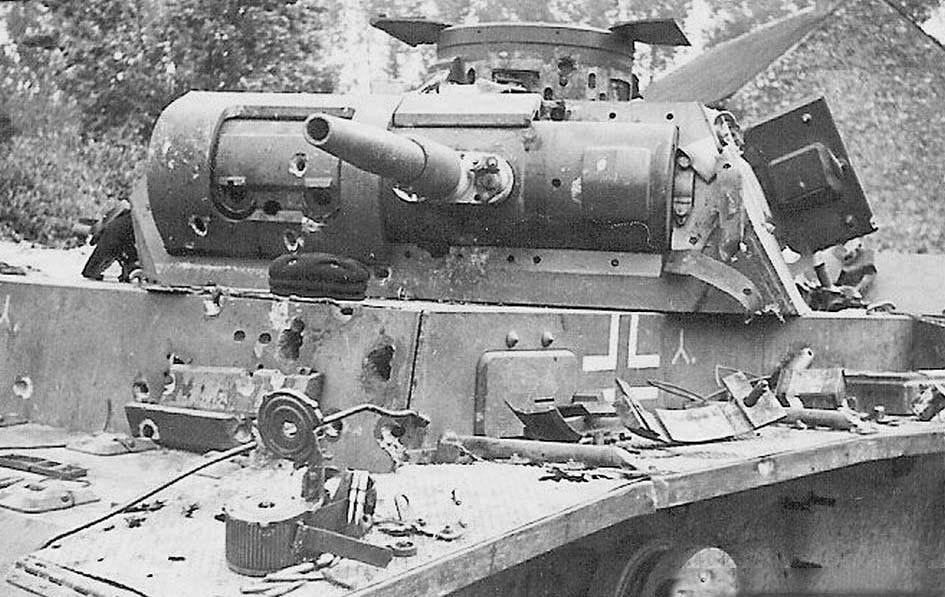
It’s a shot of a knocked-out German tank from World War 2. It’s clearly taken a lot of damage and, while it’s probably not a complete write-off, will require a fair amount of effort to fix it. The photo has no caption, no date or location.
So what exactly are we looking at and what other information can we glean or deduce from it?
Background Features
Other than the tank, we see only foliage and the side of a rather basic building, perhaps a house or barn. Detail is sparse, so there’s little information to be had here. The only thing we can be confident of is by looking at the foliage. It’s abundant, thus indicating it’s late spring, summer or early autumn.
The Tank
It’s a German medium tank, the Panzerkampfwagen III, often abbreviated to PzKw III or Pz III. This was the main German combat tank of the first half of WW2. The model was continuously upgraded throughout production, with increased armour, firepower and more. As regards which version this is, from certain details1 in the photo, we can be fairly certain it’s a late version F or Ausf. F, (in German, version = Ausführung, often shortened to Ausf.). The Ausf. F was produced from late 1939 to mid 1940.
Markings
The tank has 3 markings visible on its dark grey and brown paint finish.
Firstly, a white German cross (Balkenkreuz) applied directly onto the paint. There appears to be no black paint inside the cross, something which was standardised around 1940/41.
Secondly, there are 2 instances of the divisional insignia of 5. Panzer Division. In the photo below, it’s the inverted Y with a dot next to it painted in yellow. The first instance is on the hull side, clearly visible next to the Balkenkreuz (circled in yellow). The second is on the driver’s plate at the front of the tank, on the far left of the photo (yellow arrow).
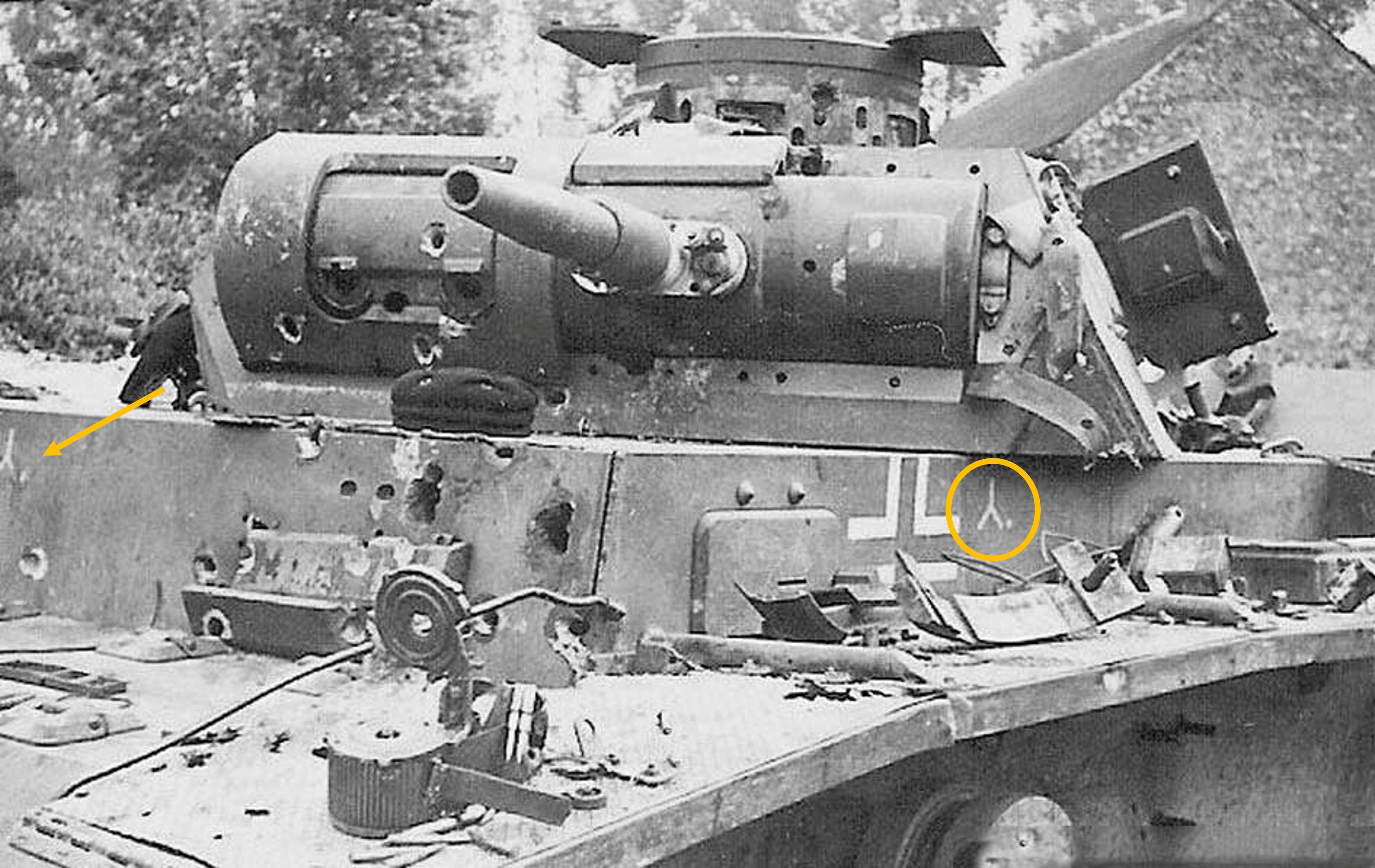
In this case, both markings actually help us provide a rough date and place to this photo.
This style of Balkenkreuz was purposely less visible than the solid white or yellow crosses used in the Nazi invasion of Poland. The solid crosses had been used as aiming points by Polish anti-tank gunners to great effect. The newer style of Balkenkreuz was adopted after Poland had surrendered, so the photo had to have been taken after September 1939.
Also, the divisional insignia shown was used during the campaign in the west in 1940; not before or after. So we can say with a high degree of confidence that the photo was almost certainly taken in the early summer of 1940 in Belgium or France. If we were to delve more into the history of this division, we might be able to suggest or even confirm the location of this tank and the unit that put it out of action.
Damage
There’s a LOT of damage here. The tank may have been in a fierce battle or perhaps was knocked out, then used as target practice by the enemy. We have no proof but given the fluid conditions of the campaign in the west in May/June 1940, the western allies would have had very few chances to sit back and leisurely test their weapons against a knocked-out German tank. I suspect therefore the damage was probably inflicted during one of the more intense battles in that summer.
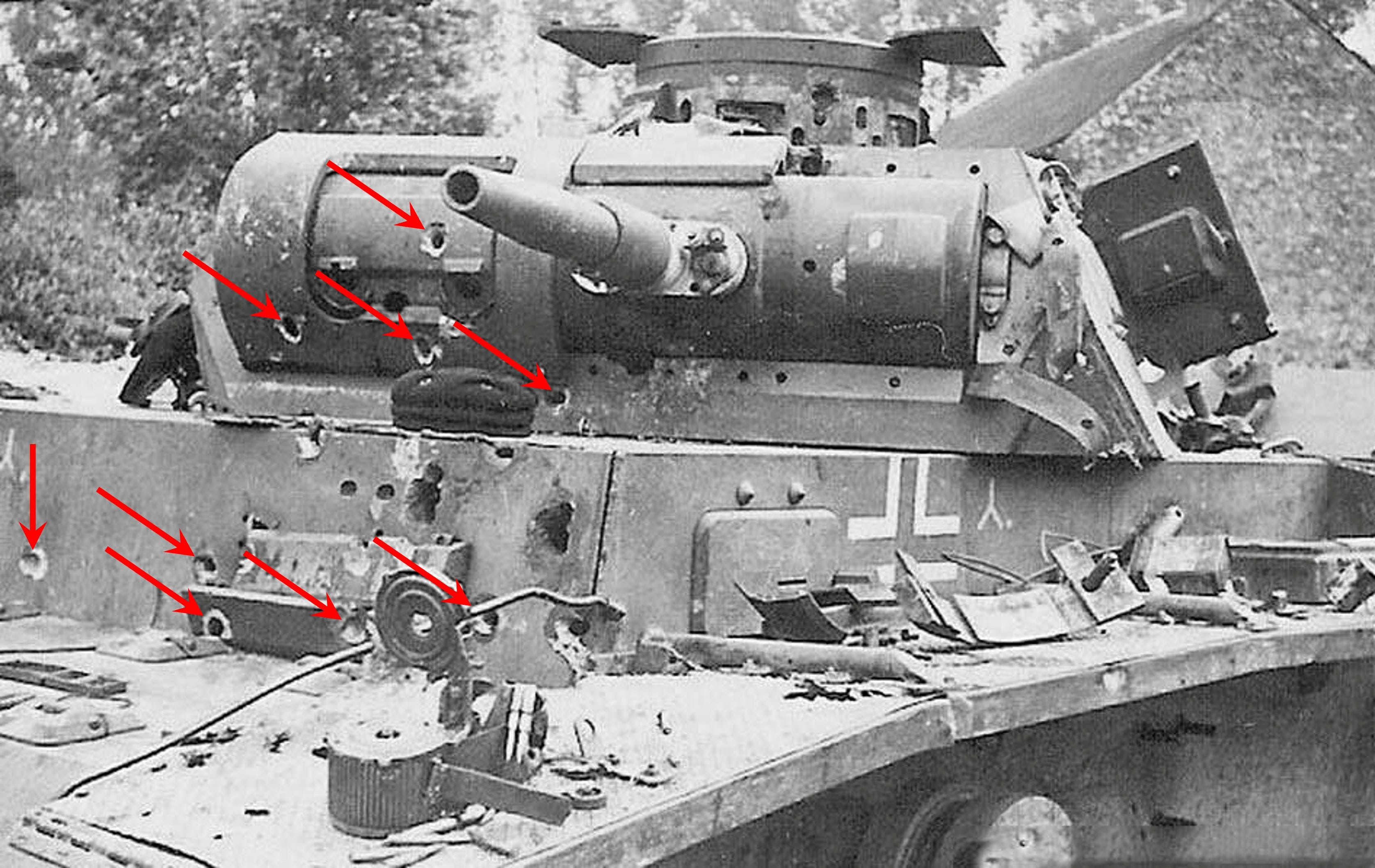
It looks like the vehicle was hit by at least 3 types of projectile. Although we have a rough guide to the size of the projectiles (the tank’s main gun aperture is 37mm wide), due to the angle of the photo and collateral gouges in the armour plate around the impacts, an accurate identification of the weapons which damaged the tank is difficult.
On the turret front and around the driver’s visor are a number of small calibre hits, some of which may have penetrated the armour. These impacts - some of which are highlighted by red arrows in the photo below - could be hits by anti-tank rifles or perhaps even a small calibre anti-tank gun such as the 25mm French Hotchkiss SA 34.
Above and to our right of the driver’s visor are 2 larger impacts (yellow arrows), which seem to have penetrated the 30mm armour. These seem to be hits from a larger calibre weapon, possibly a 37mm gun. There is a penetration between the two machine-gun ports on the turret front to the right of the main gun. This could be from the same weapon.
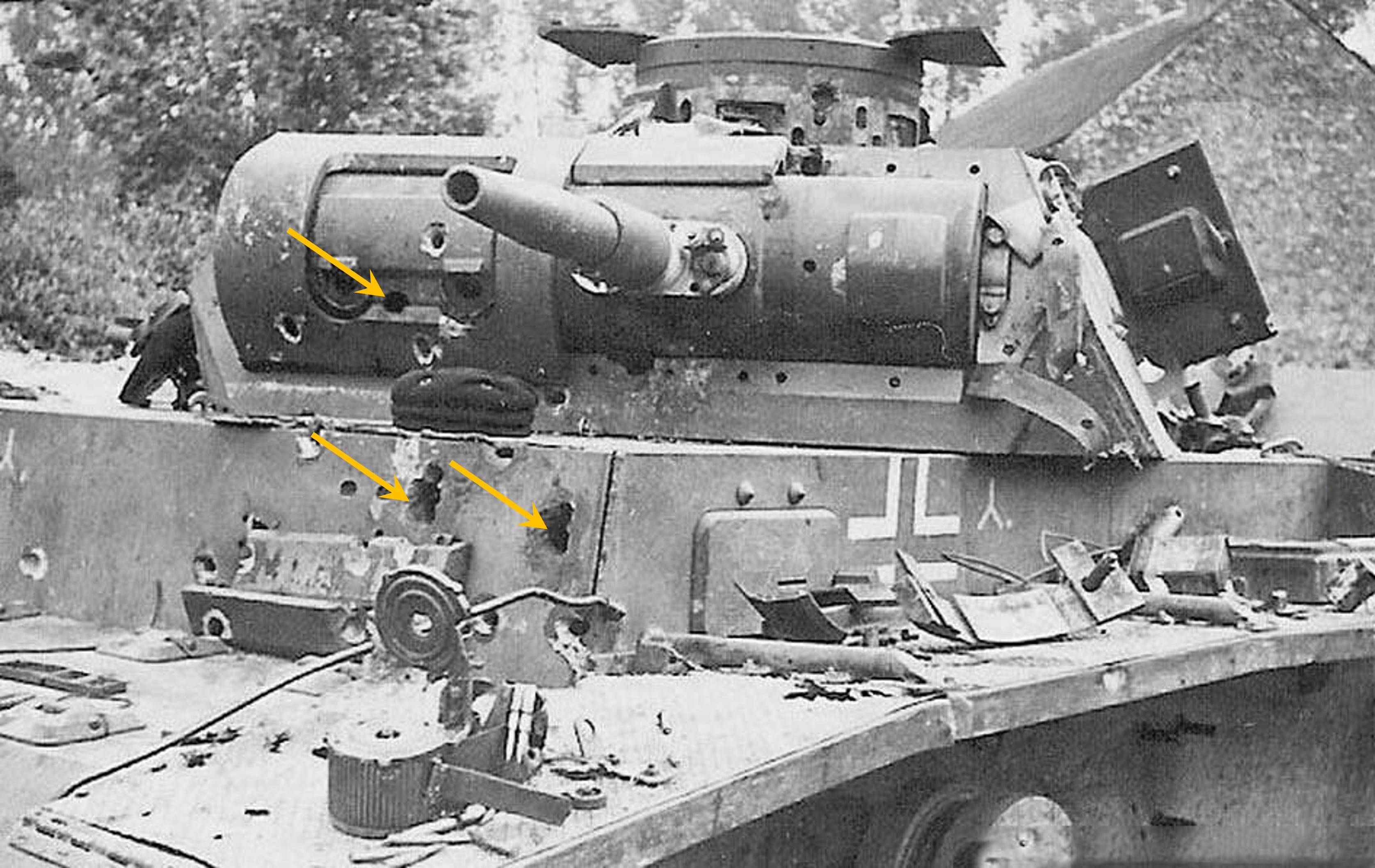
Finally, the left side of the turret front (i.e. to our right of the main gun) has been badly damaged. The exterior mantlet has been broken and half of it ripped away. There is a shell impact under the main gun (arrow 2). This type of impact – a shallow wide splash, rather than a narrow penetrating hit – and the amount of damage indicates this is likely to be the impact of a medium-calibre high explosive (HE) shell. Insufficient to penetrate the 30mm armour, yet with enough power to separate and smash the exterior mantlet armour.
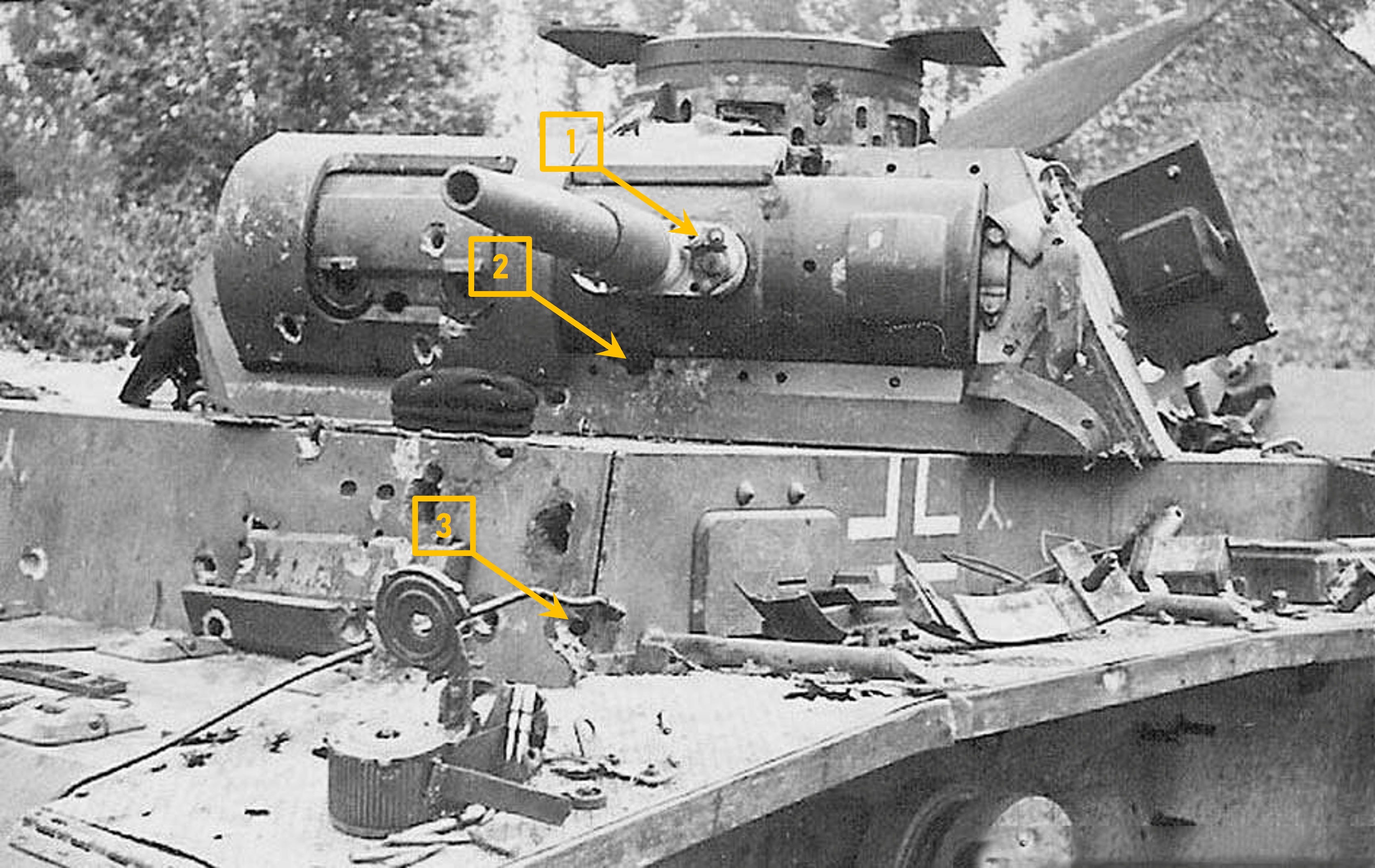
The light-coloured paint at the base of the main gun (arrow 1) shows that the armoured cover for the main gun’s recoil system is missing, possibly dislodged by the explosion of the HE shell.
On the corner of the driver’s plate and the tank’s left side of the superstructure is an impact which appears to have gouged and just penetrated the armour (arrow 3). Of more interest is the fact that this hit seems to have split the weld which held these two armour plates together.
Other Damage
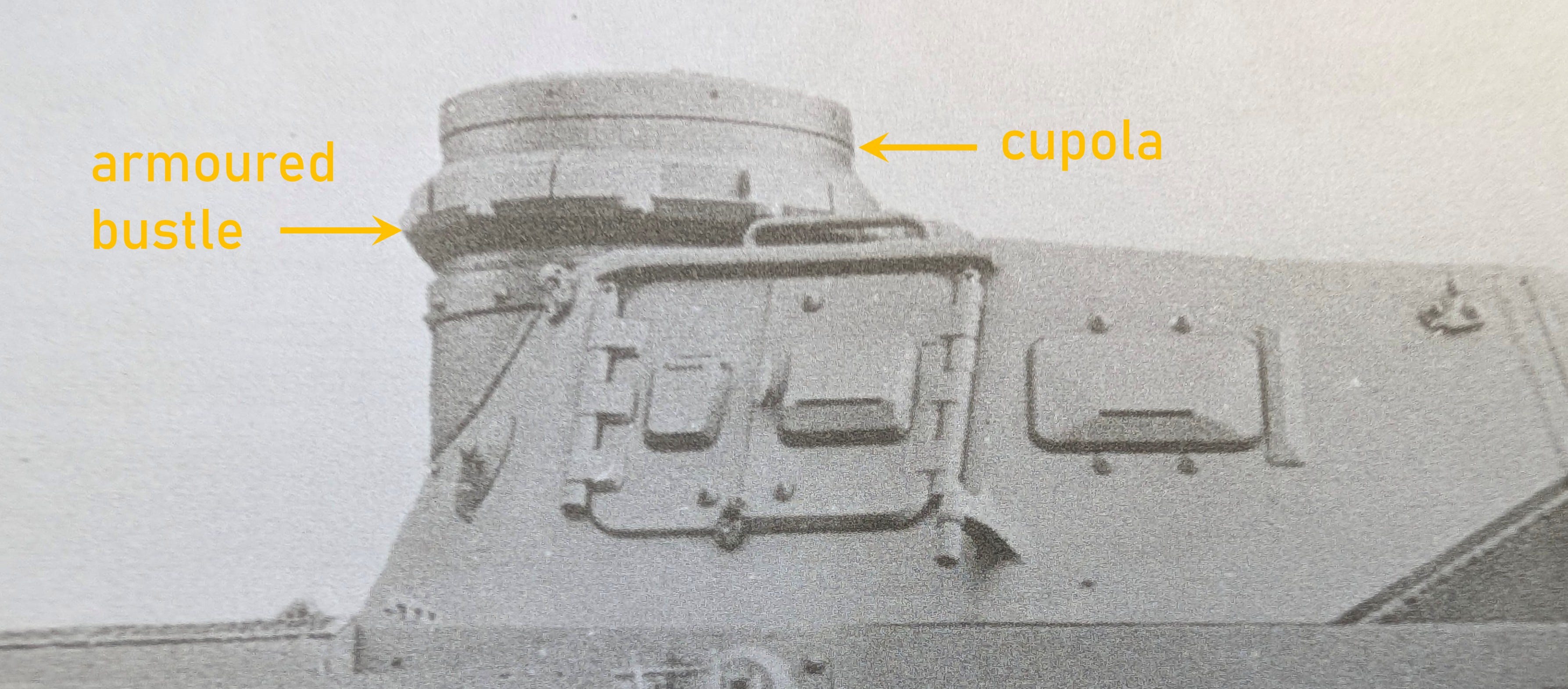
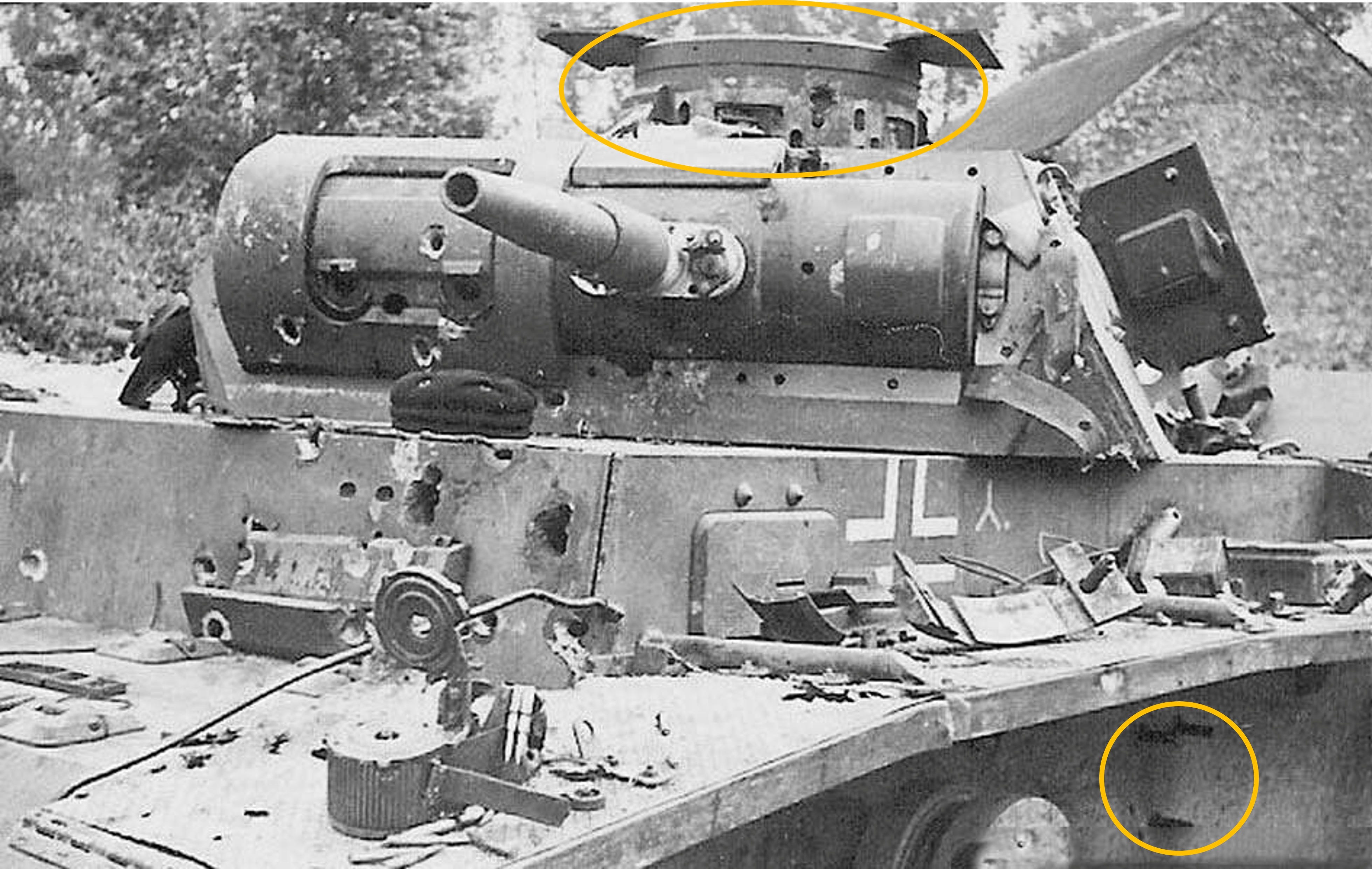
The commander’s cupola has also been wrecked. The type of cupola fitted to the PzKw III Ausf. F had a multi-piece stepped armoured bustle at its base, to protect the vision blocks in the cupola as well as the tank commander’s head. This bustle is missing and at least one impact is visible on the cupola. Some of the vision blocks are clearly visible. Parts of the bustle seem to be lying on the tank’s left trackguard.
Looking at the running gear, we can see that the left track is missing from the vehicle as is the middle return roller. All that remains of that and its mounting are the three bolts which held it onto the hull. Was this wheel assembly destroyed in battle? Or ‘borrowed’ by a passing German tank maintenance unit as a useful spare part?
Conclusion
To recap, from the detail, this appears to be a German PzKw III Ausf. F medium tank from 5. Panzer Division, likely built in early 1940 and almost certainly knocked out in France or Belgium in May/June 1940. It appears to have been stripped of tools, machine guns and other useful parts.
But the main conclusion to draw here is not immediately evident in the photo. It’s rather that the dreaded German panzers were not the formidable machines that were portrayed as such and feared in 1940. Polish anti-tank guns had already proved that nine months previously. Back in the early years of WW2, Nazi Germany’s tanks were no more formidable than their British or French opponents.
The PzKw III may have been the Nazis’ main combat tank, yet as we can clearly see, well-aimed, standard artillery or tank weapons were easily able to stop it and put it out of action.
Comments
Have you spotted a typo or an error? Or have you anything else to contribute? Then please click the button below to get in touch.
Notes
1 The driver’s left visor on the superstructure side is of the pattern applied to the Ausf. E, F & G. The driver’s front visor however is the earlier type fitted only to the Ausf. E & F. The false periscope housing which was fitted on the turret roof on all versions up to the F is missing. This feature was deleted during the production run of the Ausf. F. So by deduction, this is almost certainly a late Ausf. F tank.
Sources
Panzer Tracts 3-1 & 3-2 - Jentz & Doyle
Panzer Colors II - Culver
The algorithm showed this to me fairly randomly (I am interested in conflict history but not really in weaponry). I really appreciated reading it. It is fascinating to observe a expert analysis of clues and you explained it in a way that is rewarding to read. Thanks.
I just listened to an interview with the writer and teacher George Saunders. He said that the goal of a writer is to have your reader read the next sentence. You do this admirably! I have little interest in the topic but found your presentation, from the note, the headline/subheadline, and essay itself, to be compelling. Well done!